


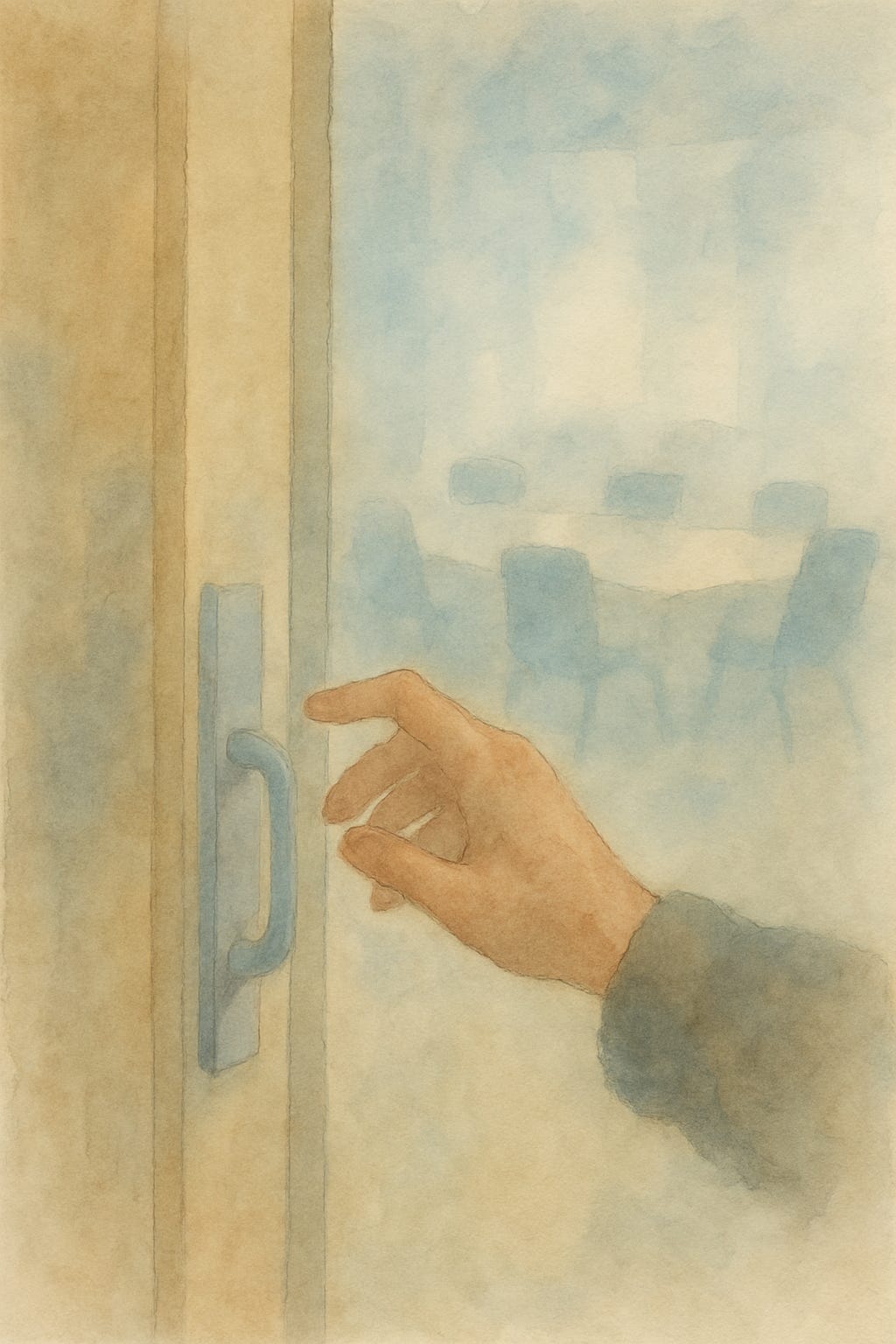
Some moments enter us before we ever enter the room.
There are moments when something inside us leans forward before we do.
A quiet tension settles under the ribs.
The breath becomes a little shorter.
The mind begins arranging possibilities in the background.
No alarm is sounding.
Nothing has gone wrong.
Yet the body prepares as if something has already begun.
It is not fear.
It is not crisis.
It is the subtle ache of anticipation, the sense of being slightly ahead of yourself.
And sometimes, what we are anticipating is not even our own story.
It is a story handed to us.
A description of frustration.
A warning of conflict.
A quiet suggestion to brace.
A narrative can arrive long before the moment itself, and the body responds to it with remarkable loyalty.
A Scriptural Echo
Jesus speaks of tomorrow with striking simplicity.
Do not worry about it.
Not as a correction.
Not as an expectation that we silence our humanity.
As a reminder that God meets us in what is real, not in what is rehearsed.
Throughout Scripture, transformation does not take place in imagined futures.
It happens in the ground we are standing on.
Presence is where formation unfolds.
Presence is where grace gathers.
What the Nervous System Understands
The mind, however, is designed to anticipate.
It scans.
It projects.
It prepares.
This is the body’s way of caring for us.
It is protection, not flaw.
But when anticipation merges with an inherited story, perception begins to bend.
Possibility begins to feel like inevitability.
The imagined becomes more vivid than the real.
And without noticing, we enter a moment already shaped by something that has not yet happened.
What Actually Happened
I carried one of these inherited narratives into a recent conversation with key stakeholders.
I had been told to expect difficulty.
Raised voices.
Defensiveness.
A room charged with frustration.
My body believed the story.
My attention narrowed.
I walked in prepared for a moment that was not yet mine.
But when the conversation began, the room felt entirely different.
Their concerns were steady and human.
Their tone was thoughtful.
Their hope for clarity was not combative but vulnerable.
As I settled into the actual moment, the imagined one began to dissolve.
The story I had been handed loosened its grip.
There was a small shift in me, almost like an exhale I had been holding without noticing.
And in that softening, something became clear.
I could hear them.
Not through strategy.
Not through preparation.
Through presence.
Then an even gentler realization rose.
We were not standing on opposite sides.
We were not adversaries.
We were, in fact, aligned.
I felt a slight release across my shoulders, a quiet sense that the room had more space in it than when I entered.
The conflict I anticipated did not exist in the room.
It lived only in the story that shaped my arrival.
The moment was far softer than the fear.
Far truer than the narrative.
The Quiet Realization
Anticipation is part of being human.
Preoccupation is what confuses us.
Anticipation helps us stay awake to possibility.
Preoccupation persuades us that possibility is already happening.
And so often, I am learning that the emotional weight I feel before a moment is not born from the moment itself.
It comes from the story behind it.
A story inherited from others.
A story colored by past seasons.
A story my body absorbed without meaning to.
When I loosen that story, even slightly, the moment becomes clearer.
More grounded.
More merciful.
Most of the time, the moment is not asking for defense.
It is asking to be seen for what it truly is.